It turns out that suspense is just not something I’m good at writing so I wrote this little thing instead to reflect the darker, gothic stories we’re reading in class. It’s also slightly Wicked-y-ish, and I don’t usually (read: never) write stories like this, so it was fun to get out of my comfort zone a bit.
~
Warnings: horror(?), abuse, a brief skim over torture, some gore, arson, just some peculiar stuff and overall darkness. Was it all really necessary? Ehm, probably not.
~
When she had been roughly dropped off at the hospital late one night, she was nothing but a mess.
Her face was flayed and her head was cut open; skin was harshly healing against her blonde hair, and blood dripped down her thighs and pooled at her ankles. Her hands and feet were burnt, the skin already starting to peel. She could only whisper, “Fire,” over and over and over. Apparently it sounded like a broken record—a mantra, some call it.
She was young and beautiful, not over the age of fifteen. She could be any ordinary young girl, but those wide and distinct green eyes of hers were distinctive. This was Anna Novak, the youngest heir to the Novak nobility, and it just so happened that recently, she was the last remaining one.
By the time she had entered the hospital, she was no longer whispering. She screamed and yelled, and it echoed in the empty hallways and white walls.
She did everything to make any of her nurses miserable—bite, kick, scratch, scream. It caused everyone harm and no one wanted to take care of her. That is why she was put in her own room, with white soft walls, and she couldn’t harm herself or anyone.
She stayed that way for three months. They electrocuted her, beat her, and she starved herself. She told me recently it is because she wanted to die. I do not blame her; they tortured her.
I first stumbled upon her name when reading the newspaper. The headlines were bold, yelling, “NOVAK FAMILY FOUND DEAD IN FATAL HOUSE FIRE. NO TRACE OF WEALTH LEFT BEHIND. ONLY REMAINING OFFSPRING IS THE BASTARD CHILD, ANNA, OF JONATHAN NOVAK II. SOURCES OF THE FIRE REMAIN UNKNOWN.” It was too coincidental. The fire, it’s mysterious causing, and her being the only one alive. The question was: why did she do it. How did she do it.
I researched and read through the family’s history. I tried to get to know her without meeting her, and a piece of me inside still wishes I did not. It was brutal—her whole lineage seeping with rape and abuse and slavery. She was not supposed to be any different from any of her family members.
Until now.
The moment I first laid eyes on her, she was thin and frail, and decay danced on her cheeks like a blush may on a young lady her age. The blonde hair that they first described was now matte and sodden and lay on her shoulders like strings; she looked like a broken porcelain doll.
Yet I knew who she was; I felt it in my stomach.
For two months I did this—observe the young girl and her tendencies, waiting for something to happen. Nothing had.
When I decided to approach her, I entered the room on my own accord, much to the disapproval of the doctors and nurses around me. They were afraid of her, even thought had not used her powers to the full extent. Cowards, I thought. If they knew who I was, they’d scream and run away.
As door opened, the smell of rust and urine shriveled my nostrils. “Hello,” I greeted her. Of course she did not reply; I did not expect her to. “I am going to take you away from here,” I continued. “This will no longer be your home.”
Although, it was most definitely not a home. It could never be a home. It reeked body odor and fecal matter of the ill patients that are not taken care of. Their heads are always bleeding as they hit them against the tile walls repeatedly, and they damp their own beds. Anna was never insane; she was never sick like these people were, but spending so much time here had made her.
To get her out of that room is as hard as you could possibly imagine. It took ten nurses and two doctors for her to even get into my car. Her strength was uncanny—something normal for people like us. They handcuffed her hands and legs, but I knew that if she tried hard enough, she could get out. She did not, of course. She was not aware of her body’s capabilities.
You should know that my home is very far away from the hospital. I talked to her to pass the time, telling her of how lovely her life was going to be when we got to my house, and how she would never have to enter that wretched building ever again. She did not reply. In fact, it took her hours.
Until after an hour of utter silence, I said, “I know what you can do.”
Her first reaction was to look away from me. I did not look down at her, and licked my lips. “I would not worry. I am the only one mad enough to suspect it.” I looked down at her and glanced at her eyes. She was petrified and suffering. I remember the horrible things I read—no electroshock therapy could ever make her forget; I knew that. “Did you do it?” I asked quietly. “I would not blame you.”
It took a while before Anna hesitated and shook her head. She still did not look up at me. I sighed. “You did not do it?” I ask again.
“No.” Her voice is soft and scratchy, as if it was the first time she had spoken a word in a while. It probably was.
I gave her a pointed look, one much of annoyance. “Anna.” Her head turned to me at the sound of her name. “You do not have to be scared of me. Believe me, I have done far worse.”
“Like what?” Her voice trembled. I remembered how she was still such a child.
I clicked my tongue. “I will tell you if you tell me the truth.”
She had looked scared. “No,” she repeated. Her voice was now clear like a bell ringing softly in the distance.
“Anna.” She had begun to cry, and was no longer looking at me. “Did you burn that house down?”
Her eyes were glued to the road in front of us. She stopped crying and a deep crease in between her brows formed, as if she was repressing a memory. I waited, even though I knew the answer.
And suddenly, it came, an answer that was so soft it could be a part of the wind. In one breath, she whispered, “Yes.”
~
Insert: the tale of anna novak.
Once upon a time there lived the noble Novak family. They were extremely wealthy from generations upon generations of hereditary money. No one in the family knew how they got it, but it was theirs and that’s all that mattered.
Jonathan Novak II was the patriarch of the family. His wife Rebecca, produced three children—two sons, one daughter. The eldest was Jonathan III, the second eldest was Elizabeth, and the youngest was Maxim. In that household, there were many servants. One of them, specifically, was a young woman named Charlotte. Now Charlotte was beautiful. Her hair was curly, her lips were full and red. She walked with grace and poise and her body was thin and fit.
It was more of a curse than a blessing for that beauty did not go unnoticed. The elder Jonathan would frequently usher her into his study, and when screams were heard from behind his locked door, the immediate response of the rest of the family was to go outside, or to play some music very, very loudly. In fact, the other men in the household would wish to do the same, however, she was their father’s and no one else could touch her.
One night, Charlotte had come to the dark realization that she was pregnant. It was painful, and she hated it. She cried every night, and drank concoctions and liquids in hopes of killing the life inside her. In the end, it did not work, and instead she gave birth, alone, in the servant chambers. The potions may have not harmed the child, but ultimately it harmed Charlotte, and she passed away as soon as the baby was born.
The other servants heard the cries of the child. It turned out to be a girl. When Jonathan II had heard of what become of Charlotte, he immediately asked for her mother’s body, and had the young child work with the servants. She became known as the bastard child, receiving hate the moment she stepped onto this world, labeled as the least favorite of all the children.
She was given the name Anna—simple, nothing special, but pretty. It is what everyone expected her to grow up to be for her mother’s beauty certainly tainted her face. It was the same dark green eyes, same blonde hair, and same simple beauty that made her beautiful—but as another target for the Novak children as her mother was to their father, now grown up into young adults. They threatened her and beat her to the point where she no longer spoke in fear of upsetting someone. People outside of the Novak home thought she was crazy, refusing to eat or speak in fear.
It continued for years.
Then one day, the house burned down.
The burning of the Novak home had been a peculiar one. There had been so many corpses, the bodies of all the servants charred. With so much decay, the Novak nobility was assumed to be a part of it. The villagers quickly demolished the house, however, none of the bodies that were found carried the bone structures of Novak ancestry. Those bones were from the Eastern side, the servants' side, but none coincided with the Novak line. As even the DNA of the family had somehow perished, the only surviving piece left was Anna—crazy, stupid, Anna. It was decided that she would be left at the hospital instead of an orphanage.
She was considered to be insane anyway.
~
“How did you do it?” She was silent again. One worded answers seemed popular at the time. “Anna. I know that you did it.” I narrow my eyes at her. “How.” Lighting a match was hard, even for me, let alone an entire house. No regular fire could make those bodies disappear. It had to be from a fire of my descent.
She let out a shaky breath. “No.”
As soon as she uttered those words, I stopped everything. She jerked forward at the sudden cease, and I looked at her.
“Anna. You are a special girl. These are things you are not supposed to be afraid of.” I looked at her harshly, waiting for her to admit it, waiting for her to do something.
“You can do things with your mind, right?” She does not answer me, but stares, expecting me to continue. So I do. “You set that house on fire. You made sure those bodies disappeared.” Her eyes widen. “Yes,” I say, acknowledging her surprise, “I am aware.” I stared back at her. “How did you do it?”
She shook her head and cried. “I did not want to kill them.” It was the longest sentence she had uttered, but it was not what I wanted.
In annoyance, I grumbled, “That’s in the past. Death is always in the past, it’s never present. Well,” I chuckled, “at least for us.”
Anna begun to shake. “I am sorry.” She continued to cry, snot dripped down her chin. “But I do not want to tell.”
I pursed my lips together, unsure to trust her, but I quickly realized it was my only option. “Very well.”
And it was silent until we reached my home
~
I was tired from the night’s travel by the time I got home. It was late and I had not eaten for a while. The bell rung when I opened the door. I looked back at my companion. “Welcome to my store.”
I watched her observe every part of it. It was covered in antiquated furniture, old windows, clothes, jars of liquid, and what I assumed she found to be most odd—little pieces of body parts kept in little jars.
At the sight of them, Anna looked up at me. “I’m a curiosity vender and mortician. This is quite normal.”
I found it amusing how she simply nodded and continued to look around, as if these were normal every day objects.
“But,” I said, as she looked up at me, “this is not my house.”
Her eyebrows furrowed together in confusion. “Oh.”
I laughed. “Follow me.”
And so she did.
All the way in the back of the store far from what can be seen from any corner you may stand in, is a wooden panel with a large dark design going down it. With a small lick of my thumb, I ran it down from the top of the dark stem-like design until it reaches the hilt at the bottom. It was the most beautiful doorknob and entrance way anyone may possess.
As soon as the door opened, and a rush of air hit her, Anna gasped out loud at the sight of everything.
She looked up at me in awe. “Who are you?” she asked quietly.
I looked down at her bright green eyes and smiled. This was where we belonged, where judgement falls at the sight of the wooden door and we can live freely as one body—one species, if you may. “Who are we, my child.” I opened my arms towards what was past that door. “Welcome home.”
~
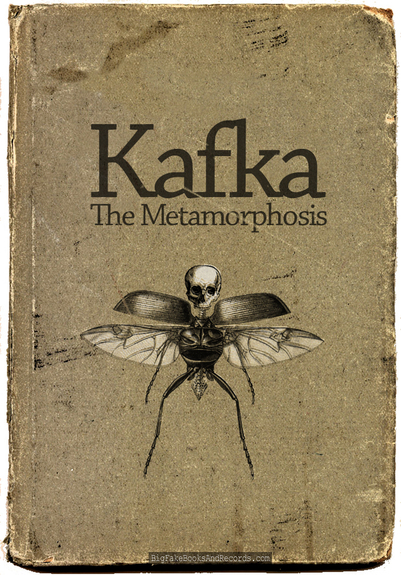 It is hard to believe that a hard-working, healthy man could turn into a bug overnight, and with good reason. But I believe that Gregor had actually never turned into a bug at all. I think that his metamorphosis was all an illusion created in Gregor's brain. What actually had happened was his family, although very dependent on Gregor for financial support, was actually not benefiting from Gregor's charity. His father had grown old and lazy, his mother the same, and his sister did nothing but play the violin. His family realizes this and begins to start working. Gregor believes they do this because he is not able to support the family becuase he had changed into an "insect". Weeks go by of his family doing their own work and caring for Gregor, and everyone seems to be getting healthier, except for Gregor. Soon the family decides that the way things are going, they would be better off without Gregor and his needs. The wound from the apple and his crippling starvation cause the death of Gregor's insect form, but it actually symbolizes Gregor's separation from the family. Once the family is free of Gregor's weight, they take a trip into the city and discuss their future, which were "exceedingly advantageous and especially promising" (Kafka 55).


